Beyond Band-Aids: How Regenerative Medicine Heals Joints and Spines
Beyond Band-Aids: How Regenerative Medicine Heals Joints and Spines
Living with chronic joint or back pain can be physically and emotionally exhausting. When daily pain medications only temporarily mask the ache and invasive surgery feels like too drastic a leap, it is incredibly normal to feel stuck. Fortunately, medical science is bridging the gap between conservative treatments and surgery through the rapidly advancing field of regenerative medicine.
Instead of simply suppressing symptoms or removing damaged tissue, regenerative medicine aims to harness and amplify your body’s inherent ability to heal itself. But how exactly does it work for the complex structures of our joints and spines? Let’s dive into the science.
The Core Goal: Healing from the Inside Out
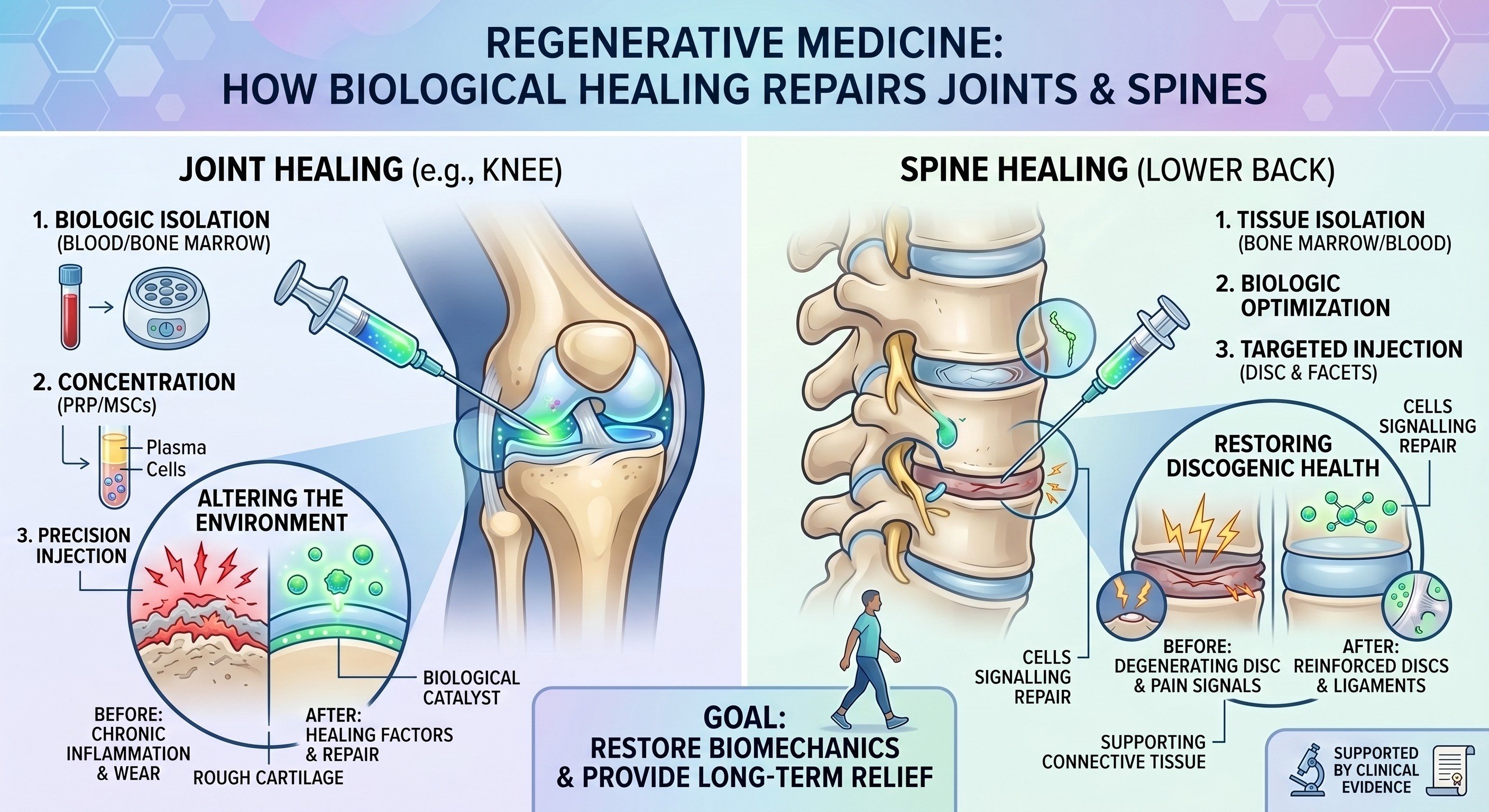
Traditional treatments—like corticosteroid injections or anti-inflammatory pills—often focus on shutting down the body’s pain signals. Regenerative medicine, however, is a holistic, biological approach. It introduces concentrated healing factors directly into injured areas (like a degenerating spinal disc or an arthritic knee) to alter the tissue environment, reduce chronic inflammation, and stimulate cellular repair.
The Key Players: PRP and Cellular Therapy
There are two primary treatments leading the charge in regenerative orthopedics and spine care:
Platelet-Rich Plasma (PRP): This therapy uses a patient’s own blood. Blood is drawn and centrifuged to isolate platelets, which are rich in potent proteins called growth factors. When injected directly into an injured tendon, ligament, or joint, these growth factors act as a biological catalyst. They accelerate tissue repair and actively reduce inflammation.
Cell-Based (Mesenchymal Stem Cell) Therapies: Mesenchymal stem cells (MSCs) act as the body's natural first responders. When introduced to a damaged spine or joint, they release anti-inflammatory signals and growth factors that slow down cartilage breakdown and support the surrounding tissue ecosystem.
How It Heals Joints
For conditions like osteoarthritis, the joint space often becomes a highly toxic, inflammatory environment. The cartilage wears down, and the surrounding tissues become chronically irritated.
Regenerative medicine heals joints by changing the microenvironment. According to clinical literature reviews on knee osteoarthritis, treatments utilizing PRP and MSCs flush the joint with healing proteins that shut down the chronic inflammatory response. This process drastically reduces pain, improves the health of the remaining tissue, and restores mobility. Evidence suggests that repeated administrations can result in superior clinical improvements, and a decrease in cartilage loss has been observed in some trials.
How It Heals the Spine
The spine is a highly complex structure that relies on a delicate balance among discs, facet joints, and ligaments. Back and neck pain often stems from conditions such as degenerative disc disease (DDD) or facet joint arthritis.
Spinal fusion surgeries permanently alter the biomechanics of your back by fusing bones together. Regenerative therapies aim to preserve your natural anatomy:
Targeting Discs: When injected into or around degenerating discs, biologic materials like PRP and MSCs promote a healthier inflammatory response. Systematic reviews indicate that intradiscal regenerative therapies are effective for managing discogenic low back pain by promoting soft-tissue healing.
Targeting Joints and Ligaments: Injecting PRP into the spinal facet joints or surrounding ligaments helps reinforce connective tissue. Recent clinical overviews suggest that PRP for degenerative spine diseases provides longer-lasting improvements compared to standard pharmaceutical interventions by addressing the underlying joint pathology.
The Takeaway
Regenerative medicine is not a magic wand, and careful consideration of indications is required before treatment. However, it represents a profound shift in how we treat musculoskeletal pain. By moving away from symptom masking and leaning into biology, these therapies offer a promising, minimally invasive path to long-term relief and improved function.
Academic & Clinical References
Ip, D., et al. (2020). Regenerative Medicine for Knee Osteoarthritis - The Efficacy and Safety of Intra-Articular Platelet-Rich Plasma and Mesenchymal Stem Cells Injections: A Literature Review. PubMed. https://pubmed.ncbi.nlm.nih.gov/33101819/
Apostolakis, S., et al. (2023). Platelet-Rich Plasma for Degenerative Spine Disease: A Brief Overview. PubMed. https://pubmed.ncbi.nlm.nih.gov/38343403/
Manchikanti, L., et al. (2024). Effectiveness of Intradiscal Regenerative Medicine Therapies for Long-Term Relief of Chronic Low Back Pain: A Systematic Review and Meta-Analysis. PubMed. https://pubmed.ncbi.nlm.nih.gov/39688822/
Treatments
PRP Therapy
Stem Cells
Sports Medicine
Contact
212-682-6970
info@ssmny.com
www.ssmny.com