PRP vs. Surgery: What’s Right for Active New Yorkers?
PRP vs. Surgery: What’s Right for Active New Yorkers?
For active New Yorkers, slowing down isn’t an option. Whether you are training for the NYC Marathon, playing weekend tennis in Central Park, or simply navigating a daily commute that includes miles of walking and subway stairs, your joints take a beating. When a knee injury or shoulder pain sidelines you, the path to recovery can feel daunting. Should you opt for the quick fix of an injection, or is it time to consider orthopedic surgery?
In recent years, Platelet-Rich Plasma (PRP) has emerged as a powerful middle ground between conservative rest and invasive surgery. But how do you know which approach is actually right for your body and lifestyle? Let's look at the science to help you make an informed decision.
Understanding the Options: Healing vs. Reconstruction
Before making a choice, it is essential to understand the fundamental difference between these two interventions.
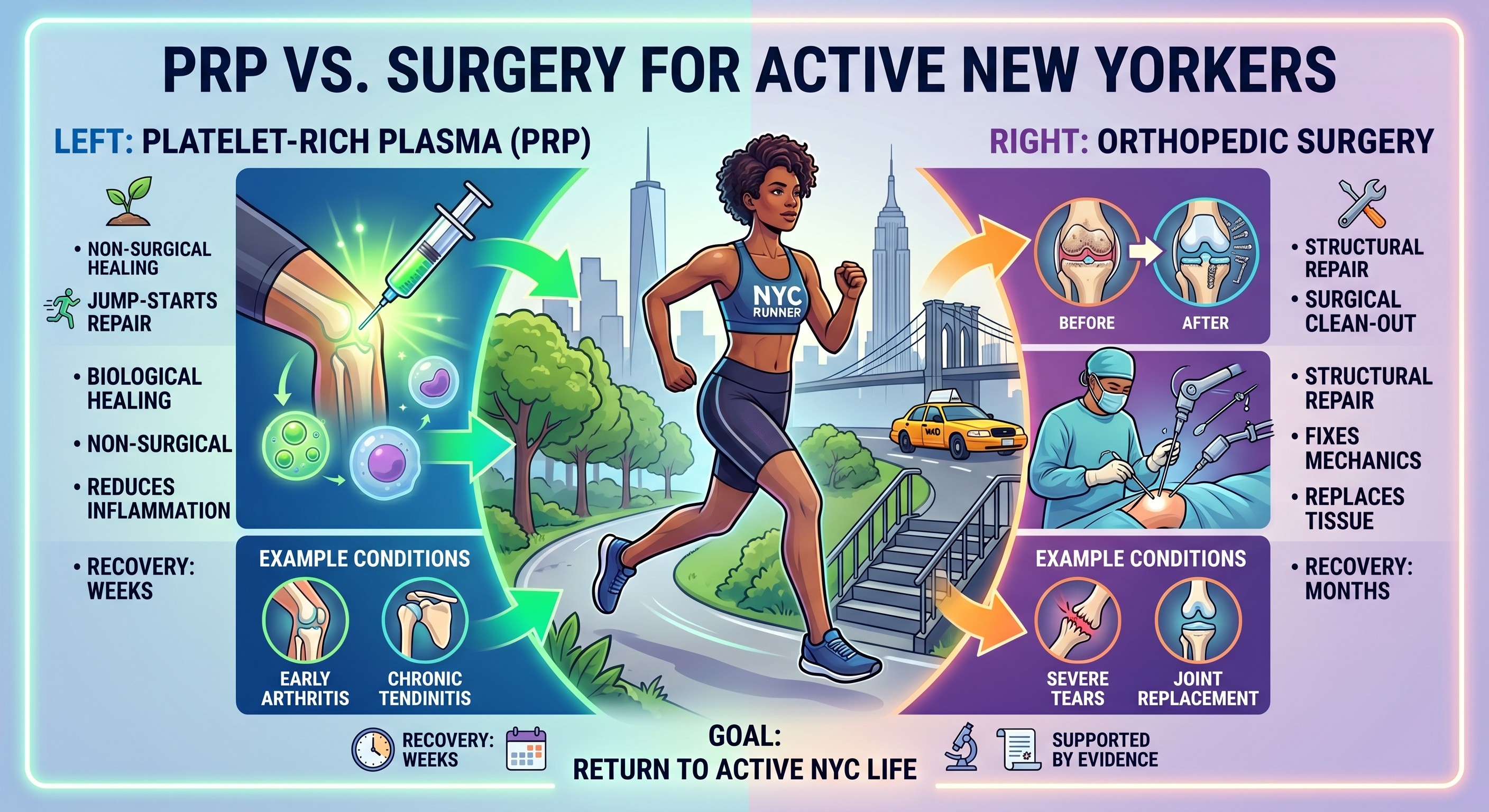
What is PRP? PRP is a biological therapy that utilizes your body's own natural healing mechanisms. A doctor draws a small amount of your blood, spins it in a centrifuge to isolate the platelets (which are rich in growth factors), and injects that concentrated plasma directly into the injured tissue. The goal is to alter the local inflammatory environment and stimulate cellular repair, essentially jump-starting your body's ability to heal itself.
What is Orthopedic Surgery? Surgery is a structural intervention. Whether it is an arthroscopic meniscus repair or a total knee replacement, surgery aims to mechanically fix, reconstruct, or replace damaged tissues that the body can no longer repair on its own.
When PRP is the Right Choice
According to the latest orthopedic literature, PRP is highly effective for specific conditions, particularly when caught early. It is often recommended for:
Early to Moderate Osteoarthritis: Clinical reviews from the American Academy of Orthopedic Surgeons indicate that PRP can significantly reduce pain and improve function in mild-to-moderate knee osteoarthritis compared with standard anti-inflammatory drugs or hyaluronic acid.
Chronic Tendinopathies: Conditions like tennis elbow, Achilles tendinopathy, and mild rotator cuff irritation often respond very well to PRP growth factors, which help synthesize new collagen.
Partial Tears: If a tendon or ligament is only partially torn, PRP can help bridge the gap and accelerate healing without the downtime of surgery.
The takeaway: If your joint structure is still relatively intact but you are dealing with chronic pain, inflammation, or a mild injury, PRP is a fantastic, minimally invasive option to get you back on your feet quickly.
When Surgery is Necessary
PRP is regenerative, but it is not magic. It cannot sew a completely severed tendon back together, nor can it grow a brand-new joint out of thin air. Surgery is typically necessary when:
Complete Ruptures: If a ligament (like an ACL) or a tendon is completely torn off the bone, the structural integrity of the joint is gone. Surgery is required to mechanically reattach or reconstruct the tissue.
Advanced "Bone-on-Bone" Osteoarthritis: Once the cartilage has completely worn away, the joint space collapses. PRP may temporarily reduce inflammation, but it cannot reverse advanced structural degeneration. A joint replacement is usually the most effective long-term solution.
Mechanical Blocks: If a loose piece of cartilage or bone is floating in the joint and causing it to "lock" or "catch," an arthroscopic surgical clean-out is required to remove the debris.
Actionable Items for Your Recovery Plan
If you are dealing with persistent joint pain, here are three actionable steps you can take right now:
Demand a Precise Diagnosis: Don't settle for "you have a bad knee." Request an MRI or high-resolution ultrasound to determine exactly what is causing your pain. You cannot choose between PRP and surgery without knowing the exact grade of your tear or the severity of your arthritis.
Ask About the "Microenvironment": If a doctor recommends PRP, ask them how they customize the concentration. The composition of PRP (leukocyte-rich vs. leukocyte-poor) matters depending on whether you are treating a tendon or a joint.
Pre-hab is Mandatory: Whether you choose PRP or surgery, the outcome heavily depends on the strength of the surrounding muscles. Start working to immediately to build strength and stabilize the joint; this will improve the success rate of whichever intervention you choose.
Academic & Clinical References
Dubin, J., et al. (2024). American Academy of Orthopaedic Surgeons Technology Overview Summary: Platelet-Rich Plasma (PRP) for Knee Osteoarthritis. PubMed. https://pubmed.ncbi.nlm.nih.gov/38295392/
Everts, P. A., et al. (2021). Platelet Rich Plasma in Orthopedic Surgical Medicine. PubMed. https://pubmed.ncbi.nlm.nih.gov/33400591/
Kon, E., et al. (2010). Platelet-rich plasma: intra-articular knee injections produced favorable results on degenerative cartilage lesions. PubMed. https://pubmed.ncbi.nlm.nih.gov/19838676/
Treatments
PRP Therapy
Stem Cells
Sports Medicine
Contact
212-682-6970
info@ssmny.com
www.ssmny.com